
About this example
We checked every comparison in the pack and they are all correct. Before publishing it we kept the denominators within the fourth grade range (halves, thirds, fourths, fifths, sixths, eighths, tenths and twelfths), fixed one teacher note whose example did not show what it claimed, and added the missing answer to one worksheet question.
It is a clear example of the procedure-plus-reasoning balance fourth grade fractions need.
Curriculum alignment: Common Core 4.NF.A.1 (explain why a fraction a/b is equivalent to (n × a)/(n × b)) and 4.NF.A.2 (compare two fractions with different numerators and denominators by creating common denominators or numerators).
What's in the pack
- 10 editable slidesTitle, vocabulary, teaching slides, a true or false check and a closing slide, in one theme.
- Lesson planA 60-minute plan with timed phases, differentiation and assessment for learning.
- Worksheet with answer key3 questions worth 12 marks, with full answers.
- Warm-up5 questions with answers to open the lesson.
- Reading passageA short text with 4 questions and answers.
- Exit ticket3 questions with model answers.
- Study guideKey vocabulary, facts and concepts on one page.
- Teacher notesMisconceptions, IEP/504 and ELL supports, and homework.
The slide deck (10 slides)
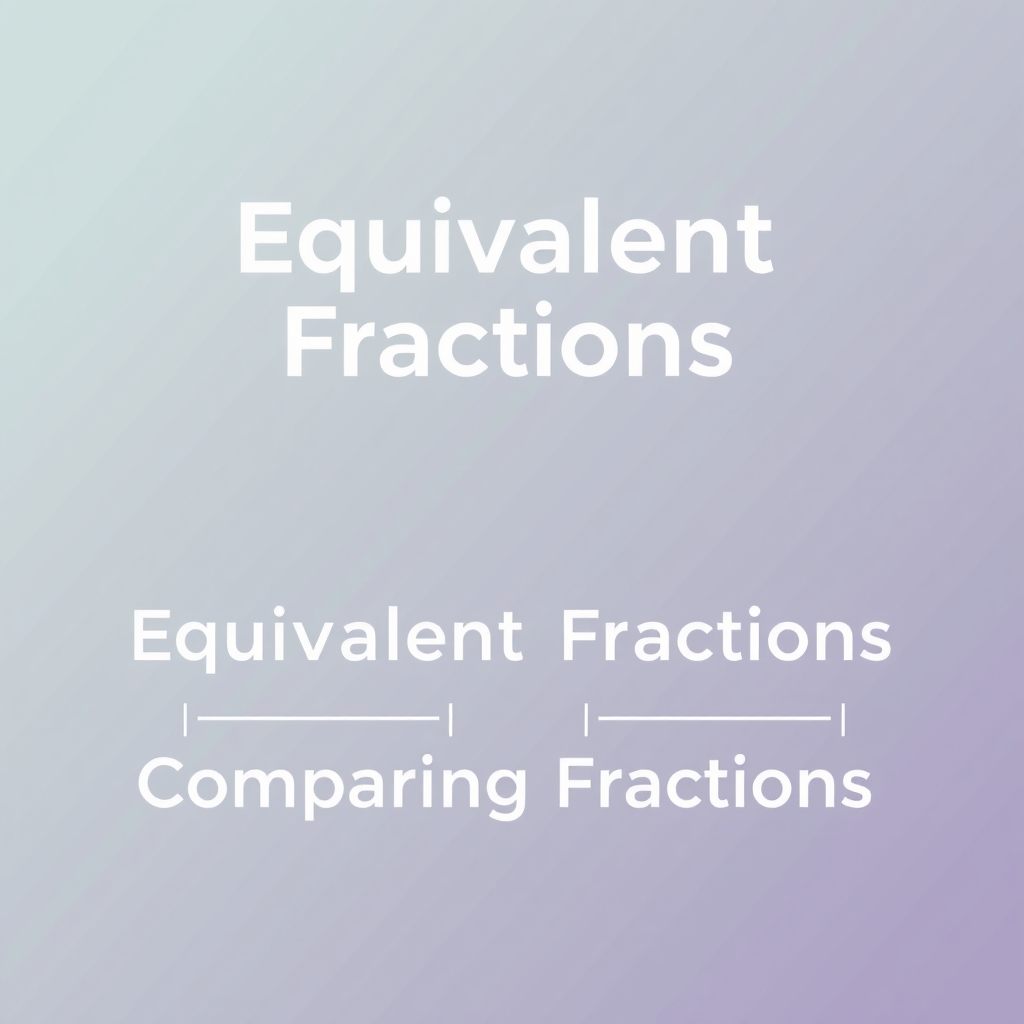
Every slide below is rendered live from the generated pack, in the Amber theme the generator picked. In your account each one is editable, and the deck exports to PowerPoint or Google Slides as real text boxes, not flat pictures. The faint LessonHQ watermark only appears on public previews.



The printable documents
The lesson plan, worksheet and its mark scheme, starter, exit ticket and teacher notes come with the slides. Pick a tab to read each one in full. They print on US Letter and download as Word, PDF or Google Docs.
Timed phases with teacher and student activity, assessment for learning, differentiation and resources.
Why this pack works in the classroom
A trap that reveals understanding
'2/3 is smaller than 4/6' is keyed false because they are equal. It works like a hinge question: the students who get it wrong show you exactly who is comparing numbers rather than amounts.
Common denominators modeled
The pack models turning 2/3 and 3/5 into 10/15 and 9/15 before comparing, so students see why the method works instead of memorizing it.
Extension that asks for reasons
Students who finish early create three equivalent fractions for 5/8 and justify them, which stretches them without simply giving them more problems.
How the lesson runs
The 60-minute lesson plan splits the lesson into 5 timed phases. This is the plan exactly as it was generated.
- 1. Starter8 minTeacher: Display retrieval quiz, circulate, prompt students to self‑mark.Students: Complete retrieval questions independently, then check answers.
- 2. Main Teaching13 minTeacher: Explain equivalent fractions, model multiplication method, then teach comparison with same denominator.Students: Listen, answer cold‑call questions, fill guided notes.
- 3. Active Learning11 minTeacher: Facilitate paired task to create equivalent fractions and compare fractions with different denominators.Students: Work in pairs, discuss steps, record answers on worksheet.
- 4. Independent Task8 minTeacher: Circulate, support lower‑ability learners, offer extension prompts to higher‑ability students.Students: Complete individual worksheet applying both methods.
- 5. Plenary10 minTeacher: Collect exit tickets, review answers, highlight key reasoning.Students: Complete three exit‑ticket questions independently.
Straight from the pack
A few pieces copied word for word from the generated documents, so you can see the level of detail.
Learning objective
I can find equivalent fractions and compare fractions using common denominators.
Learning targets
- I can identify equivalent fractions using multiplication
- I can compare two fractions that share a denominator
- I can find a common denominator to compare different fractions
- I can justify which fraction is larger using appropriate reasoning
Differentiation
- Support: Provide color‑coded fraction strips and step‑by‑step prompts for lower‑ability learners.
- Core: Students work through guided examples on the board and complete the paired task.
- Extension: Challenge students to create a set of three equivalent fractions for 5/8 and justify the choice.
Warm-up questions
- What does the numerator tell you about a fraction?
- What does the denominator tell you about a fraction?
- Write the fraction that shows one half of a pizza.
- If you multiply both parts of 2/5 by 3, what fraction do you get?
- Which is larger: 3/4 or 4/5?
Worksheet questions
- State why multiplying numerator and denominator by the same number gives an equivalent fraction.
- Explain how to compare 3/5 and 7/10 using a common denominator.
- Analyze the benefit of simplifying fractions before comparing them, and give an example.
Misconceptions it tackles
- A larger denominator always makes a fraction smaller.: Show that 3/8 is larger than 1/4 even though 8 > 4, because 1/4 = 2/8 and 3/8 > 2/8.
- Equivalent fractions must have the same numerator.: Demonstrate 1/2 = 2/4 = 3/6, highlighting the multiplication rule.
Making it fit your class
Use fraction strips or area models alongside the slides for students who need to see the amounts. For a quick check, use the true or false slide with whiteboards before the worksheet.
This pack took about a minute to generate. Yours will not be a copy of it: type the same topic and grade and you get a fresh pack, then you can change the length, the ability level and the theme before you press Generate.
Make your own on this topic
The form opens with “Equivalent fractions and comparing fractions” and Grade 4 filled in. The free plan includes 2 full lesson packs with no card needed.
Make your own on this topic →Get the editable files
This pack is in the LessonHQ marketplace, where you can download the editable slides and documents.
View it in the marketplace →Frequently asked questions
Is this a real LessonHQ lesson pack?
Yes. It was generated by LessonHQ from the topic "Equivalent fractions and comparing fractions" and grade Grade 4, in about a minute, and saved to our library. We read it and checked the facts and answers before showing it here; any small corrections are noted on this page.
Does it use fraction models?
The slides use worked examples and number lines. When you generate your own lesson LessonHQ can draw fraction bars and number lines on the slides as editable shapes.
Will I get exactly this pack if I make my own?
No, you get a fresh pack written for your request. Type the same topic and LessonHQ writes a new set of slides and documents, so you can make several versions and keep the best. You can also change the length, ability level and theme first.
Can I edit the slides and documents?
Yes. Every slide is editable in LessonHQ and exports to PowerPoint or Google Slides as real text boxes and shapes. The documents download as Word, PDF or Google Docs on US Letter paper.
How much does it cost?
The free plan includes 2 full lesson packs with no card needed, and the slide generator lets you make 3 decks without signing up. Paid plans add more packs each month.