AP World History: The Holocaust in 60 seconds
Everything you need to teach The Holocaust for AP World History - slides, a lesson plan, a worksheet with an answer key, a study guide and review practice, all built around the same key vocabulary and pitched to the AP framework. Editable and free to start.
Teaching The Holocaust in AP World History
In AP World History: Modern, the Holocaust is usually taught as the central example of state-sponsored genocide within the study of World War II, total war, and the extreme uses of state power in the twentieth century. It connects to course themes such as the role of the state, the development of ideologies, and the human and social costs of conflict.
Students should understand that the Nazi regime, led by Adolf Hitler, persecuted and then systematically murdered about six million Jews, along with targeting Roma, people with disabilities, political opponents, and others. The topic matters because it shows how racist ideology, bureaucracy, technology, propaganda, war, and public indifference or collaboration could combine to produce mass murder. Students can compare it with other genocides and mass atrocities of the century.
Key ideas
Nazi ideology
The Nazi worldview was built on racial antisemitism and the false idea that humanity was divided into biologically ranked races. Nazis blamed Jews for Germany's problems, including defeat in World War I and the economic crisis.
Persecution before mass murder
After the Nazis took power in 1933, they excluded Jews from public life step by step. The Nuremberg Laws of 1935 stripped Jews of German citizenship and banned marriage between Jews and non-Jews. Violence escalated, including Kristallnacht in November 1938.
War as a turning point
German conquest in Poland and then the Soviet Union brought millions of Jews under Nazi control. Jews were forced into ghettos, and mobile killing units known as Einsatzgruppen shot large numbers of Jews in the occupied Soviet Union.
The Final Solution
Nazi leaders developed the policy of the 'Final Solution,' the planned murder of European Jews. Killing centers such as Auschwitz-Birkenau and Treblinka used gas chambers, and deportations by rail were organized across occupied Europe.
Many targets
Jews were the main target of the genocide, but the Nazis also murdered Roma and Sinti, people with disabilities, Soviet prisoners of war, and many Polish civilians. Political opponents, Jehovah's Witnesses, and gay men were also persecuted.
Participation and response
The genocide required many participants, including officials, police, soldiers, railway workers, and collaborators in other countries. Some people resisted or rescued Jews, and there were uprisings such as the Warsaw Ghetto Uprising of 1943, but most Jews had little chance to escape.
Aftermath and justice
The Allies liberated camps in 1944 and 1945. The Nuremberg trials prosecuted major Nazi leaders, and the atrocity helped shape the idea of crimes against humanity and the 1948 UN Genocide Convention.
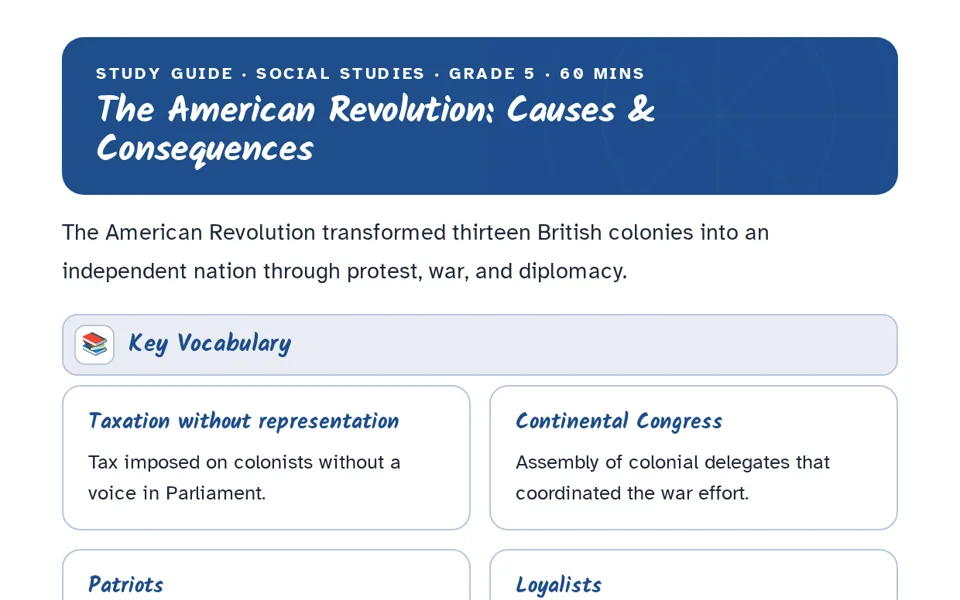
Key vocabulary
- Genocide
- The deliberate attempt to destroy a national, ethnic, racial, or religious group.
- Antisemitism
- Prejudice against or hatred of Jews.
- Nuremberg Laws
- German laws of 1935 that defined Jews by ancestry and removed their citizenship and rights.
- Ghetto
- A restricted, overcrowded area where the Nazis forced Jews to live in occupied Europe.
- Einsatzgruppen
- Mobile units that carried out mass shootings of Jews and others behind the German front in the Soviet Union.
- Final Solution
- The Nazi term for the plan to murder all European Jews.
- Kristallnacht
- The November 1938 night of anti-Jewish violence in Germany and Austria in which synagogues and Jewish businesses were attacked.
- Total war
- A war in which a state mobilizes all of its society and resources and may target civilians.
Common misconceptions
- Error: The Holocaust began with the gas chambers. Fix: It developed over years, from discrimination and propaganda to violence, ghettos, mass shootings, and then killing centers.
- Error: Hitler alone carried out the genocide. Fix: It depended on many officials, institutions, and ordinary people, as well as on a dictatorship and a supportive ideology.
- Error: Only Jews were persecuted by the Nazis. Fix: Jews were the main target of the genocide, but other groups were also persecuted or murdered, and the experiences differed.
- Error: The Holocaust happened only in Germany. Fix: It took place across German-occupied and allied Europe, with the main killing centers located in occupied Poland.
What the exam asks for
- Explaining causes and effects, such as how ideology, war, and state power combined to make genocide possible.
- Analyzing primary sources such as laws, propaganda posters, and survivor or perpetrator accounts for point of view, purpose, and context.
- Comparing the Holocaust with other twentieth-century genocides or acts of state violence.
- Building an argument with specific historical evidence, including continuity and change over time.
Practice questions with answers
Identify two steps the Nazi government took between 1933 and 1939 to persecute German Jews.
Any two accurate steps, such as the Nuremberg Laws of 1935 removing citizenship, exclusion of Jews from jobs and public life, or the Kristallnacht violence of 1938.
Explain how World War II changed Nazi policy toward Jews.
Conquest placed millions of Jews under German control, and the war provided cover for escalating from persecution and expulsion to ghettos, mass shootings, and killing centers.
Explain why historians say the Holocaust required the participation of many people and institutions, not only Nazi leaders.
Implementation needed bureaucrats to plan and record, police and soldiers to round up and shoot, railways to transport, and local collaborators in occupied lands. Many others stood by.
Evaluate the extent to which ideology, rather than wartime conditions, explains the Holocaust.
A strong response takes a position and uses evidence. It notes that racial antisemitism shaped Nazi goals and persecution before the war (Nuremberg Laws, Kristallnacht). It also explains that war enabled radicalization, through conquest of Poland and the Soviet Union, ghettos, the Einsatzgruppen, and the killing centers. It addresses bureaucracy, propaganda, and collaboration, and may compare with another genocide. It reaches a reasoned conclusion about how the factors interacted.
Make any AP World History resource on The Holocaust
Pick what you need - the AI builds it for AP World History and keeps everything consistent if you generate more.
The Holocaust lesson plans
The Holocaust worksheets
The Holocaust study guides
The Holocaust slides
The Holocaust test prep & review
The Holocaust activities
The Holocaust practice test
AP World History: The Holocaust - FAQ
Are these resources aligned to the AP World History framework?
Yes - every resource on The Holocaust is written for the AP course framework - with exam-style free-response and the scoring guidelines in mind. It is pitched for High School (Grades 9-12) and the demands of the AP exam.
What can I make for The Holocaust?
A full lesson on The Holocaust - slides, a lesson plan, a worksheet with an answer key, a study guide, review practice, an exit ticket and a self-grading practice test - each generated in about 60 seconds.
Are the The Holocaust resources editable?
Yes. Slides open in Google Slides or PowerPoint and documents open in Word or Google Docs, or save as a PDF - fully editable and yours to keep.
Is it free?
You can start free with no credit card. Generate a AP World History lesson on The Holocaust and see the quality for yourself.
Teach The Holocaust tomorrow.
A full AP World History lesson in 60 seconds - free to start, no credit card.