AP Biology: DNA and Protein Synthesis in 60 seconds
Everything you need to teach DNA and Protein Synthesis for AP Biology - slides, a lesson plan, a worksheet with an answer key, a study guide and review practice, all built around the same key vocabulary and pitched to the AP framework. Editable and free to start.
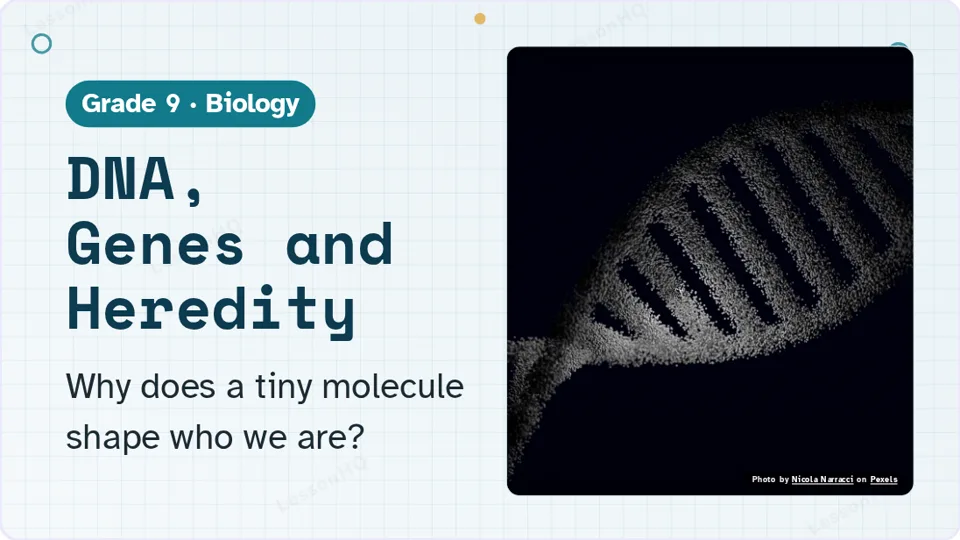
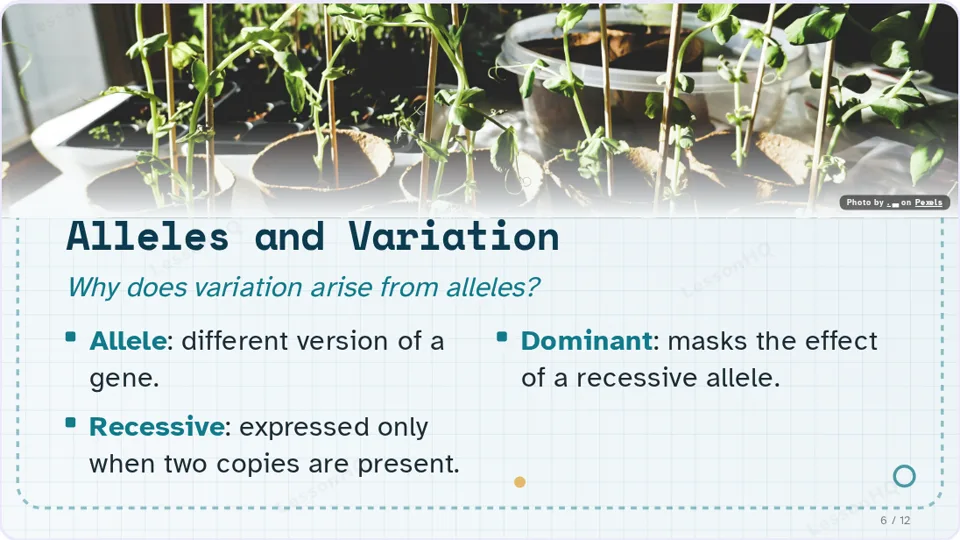
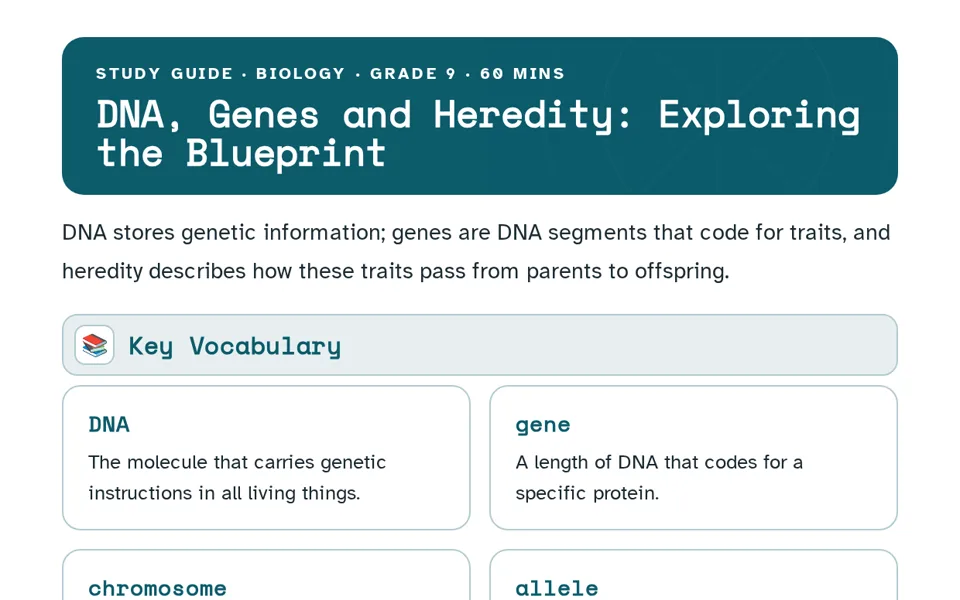
Teaching DNA and Protein Synthesis in AP Biology
This topic follows the flow of genetic information from DNA to RNA to protein. Students review the structure of DNA and RNA, then connect that structure to replication, transcription, RNA processing in eukaryotes, and translation at the ribosome. The central idea is that the sequence of nucleotides in a gene determines the sequence of amino acids in a polypeptide, and that sequence helps determine the protein's shape and function.
It matters in AP Biology because it links molecular structure to cellular function, heredity, evolution, and biotechnology. Mutations, gene regulation, differences between prokaryotes and eukaryotes, and the effects of changing a base sequence all depend on a solid grasp of this pathway. Students are expected to explain each step, predict the effect of a change in DNA, and use data or models to support their reasoning.
Key ideas
DNA structure supports its function
DNA is a double helix of two antiparallel strands. Each strand has a sugar-phosphate backbone and bases held together across strands by hydrogen bonds: A pairs with T, and G pairs with C. This complementary pairing allows accurate copying.
Replication is semiconservative
Each new DNA molecule has one original strand and one newly made strand. Helicase unwinds the helix, primase makes RNA primers, and DNA polymerase adds nucleotides to the 3' end of a growing strand. The lagging strand is made in Okazaki fragments that DNA ligase joins.
Transcription makes RNA from a DNA template
RNA polymerase binds a promoter and builds an RNA strand complementary to the template strand in the 5' to 3' direction. In RNA, uracil replaces thymine. The product of a protein-coding gene is mRNA.
Eukaryotic RNA is processed
Before leaving the nucleus, eukaryotic pre-mRNA gets a 5' cap and a poly-A tail, and introns are removed by splicing so that exons are joined. Prokaryotes lack a nucleus, so transcription and translation can occur at the same time.
Translation builds a polypeptide
Ribosomes read mRNA in codons of three nucleotides. Each tRNA carries a specific amino acid and has an anticodon that pairs with a codon. Translation begins at the start codon AUG and ends when a stop codon is reached.
The genetic code is nearly universal and redundant
Most codons specify an amino acid, and more than one codon can code for the same amino acid. The code is shared by nearly all organisms, which is evidence of common ancestry.
Mutations and regulation change outcomes
A change in DNA sequence can alter the protein, as in a substitution, insertion, or deletion. Insertions or deletions that are not multiples of three cause frameshifts. Cells also regulate gene expression, for example with the lac operon in bacteria or transcription factors in eukaryotes.
Key vocabulary
- Nucleotide
- The monomer of nucleic acids, made of a sugar, a phosphate group, and a nitrogenous base.
- Codon
- A three-nucleotide sequence in mRNA that specifies an amino acid or a stop signal.
- Anticodon
- The three-nucleotide sequence on a tRNA that pairs with a complementary mRNA codon.
- RNA polymerase
- The enzyme that synthesizes RNA from a DNA template during transcription.
- Intron
- A noncoding region of pre-mRNA that is removed during splicing.
- Exon
- A region of pre-mRNA that remains in mature mRNA and is usually expressed.
- Promoter
- A DNA sequence where RNA polymerase and associated factors bind to begin transcription.
- Semiconservative replication
- Replication in which each daughter DNA molecule contains one parental strand and one new strand.
Common misconceptions
- Error: Translation happens in the nucleus in eukaryotes. Fix: Transcription and RNA processing occur in the nucleus, while translation occurs on ribosomes in the cytoplasm or on the rough ER.
- Error: All mutations are harmful. Fix: Some mutations have no effect on the protein, such as silent substitutions due to code redundancy, and some can be beneficial in a particular environment. Mutations are a source of genetic variation.
- Error: The mRNA sequence is identical to the template strand. Fix: mRNA is complementary to the template strand and matches the coding strand, except that it contains U in place of T.
- Error: Introns are the parts that get translated. Fix: Introns are removed from pre-mRNA, and exons are joined to form the mature mRNA that is translated.
What the exam asks for
- Explaining how a change in DNA sequence could change the mRNA, the polypeptide, and the protein's function.
- Analyzing data or experimental results, such as the effect of a mutation or a regulatory condition on gene expression.
- Using models and diagrams to predict mRNA, tRNA, and amino acid sequences from a DNA sequence and codon chart.
- Justifying claims with evidence, such as why the shared genetic code supports common ancestry.
Practice questions with answers
A DNA template strand reads 3'-TACGGA-5'. Write the mRNA sequence and label its 5' and 3' ends.
5'-AUGCCU-3'. The mRNA is complementary and antiparallel to the template, with U in place of T.
Explain why the lagging strand is made in fragments during DNA replication.
DNA polymerase can add nucleotides only to a 3' end, so it synthesizes only in the 5' to 3' direction. On the lagging strand this direction runs away from the replication fork, so synthesis occurs in short Okazaki fragments, each started by a primer, which DNA ligase later joins.
Describe two ways eukaryotic pre-mRNA is modified before translation.
A 5' cap and a poly-A tail are added, and introns are removed by splicing so exons are joined. Any two of these are correct.
A single-base substitution in a gene changes a codon from one that codes for glutamic acid to one that codes for valine in a protein. (a) Explain how this could change protein function. (b) Explain how a different single-base substitution in the same gene might have no effect on the protein. (c) Describe how a deletion of one nucleotide early in the coding sequence would differ in effect.
A strong response includes: (a) The altered DNA leads to an altered mRNA codon, so a different amino acid is inserted. Glutamic acid is polar and charged while valine is nonpolar, so the change can alter folding, interactions, or the active or binding site, and therefore function. (b) Because the genetic code is redundant, a substitution may produce a different codon for the same amino acid (a silent mutation), leaving the polypeptide unchanged. (c) Deleting one nucleotide shifts the reading frame (a frameshift), changing every codon after the deletion, likely producing many wrong amino acids or an early stop codon, which usually has a larger effect than a single substitution.
Make any AP Biology resource on DNA and Protein Synthesis
Pick what you need - the AI builds it for AP Biology and keeps everything consistent if you generate more.
DNA and Protein Synthesis lesson plans
DNA and Protein Synthesis worksheets
DNA and Protein Synthesis study guides
DNA and Protein Synthesis slides
DNA and Protein Synthesis test prep & review
DNA and Protein Synthesis activities
DNA and Protein Synthesis practice test
AP Biology: DNA and Protein Synthesis - FAQ
Are these resources aligned to the AP Biology framework?
Yes - every resource on DNA and Protein Synthesis is written for the AP course framework - with exam-style free-response and the scoring guidelines in mind. It is pitched for High School (Grades 9-12) and the demands of the AP exam.
What can I make for DNA and Protein Synthesis?
A full lesson on DNA and Protein Synthesis - slides, a lesson plan, a worksheet with an answer key, a study guide, review practice, an exit ticket and a self-grading practice test - each generated in about 60 seconds.
Are the DNA and Protein Synthesis resources editable?
Yes. Slides open in Google Slides or PowerPoint and documents open in Word or Google Docs, or save as a PDF - fully editable and yours to keep.
Is it free?
You can start free with no credit card. Generate a AP Biology lesson on DNA and Protein Synthesis and see the quality for yourself.
Teach DNA and Protein Synthesis tomorrow.
A full AP Biology lesson in 60 seconds - free to start, no credit card.