AP Biology: Gene Expression and Regulation in 60 seconds
Everything you need to teach Gene Expression and Regulation for AP Biology - slides, a lesson plan, a worksheet with an answer key, a study guide and review practice, all built around the same key vocabulary and pitched to the AP framework. Editable and free to start.
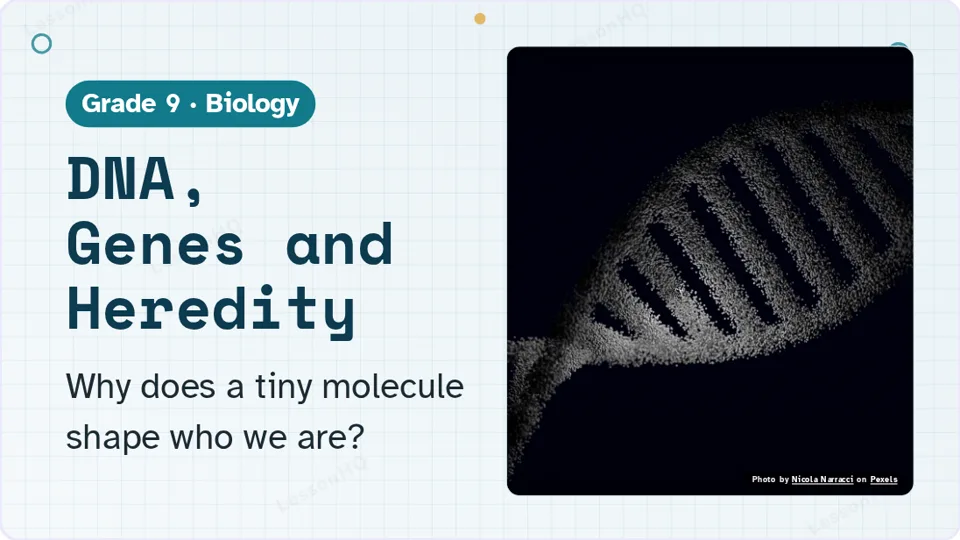
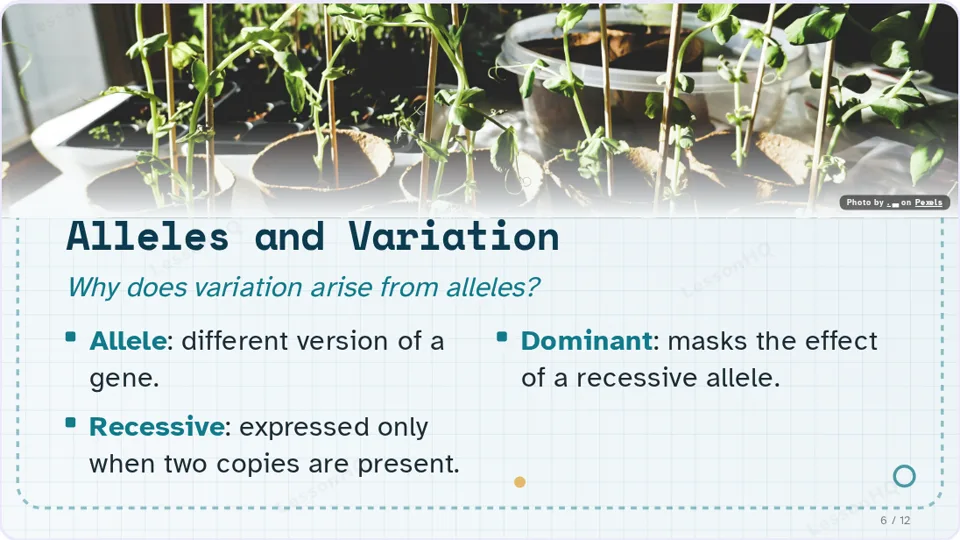
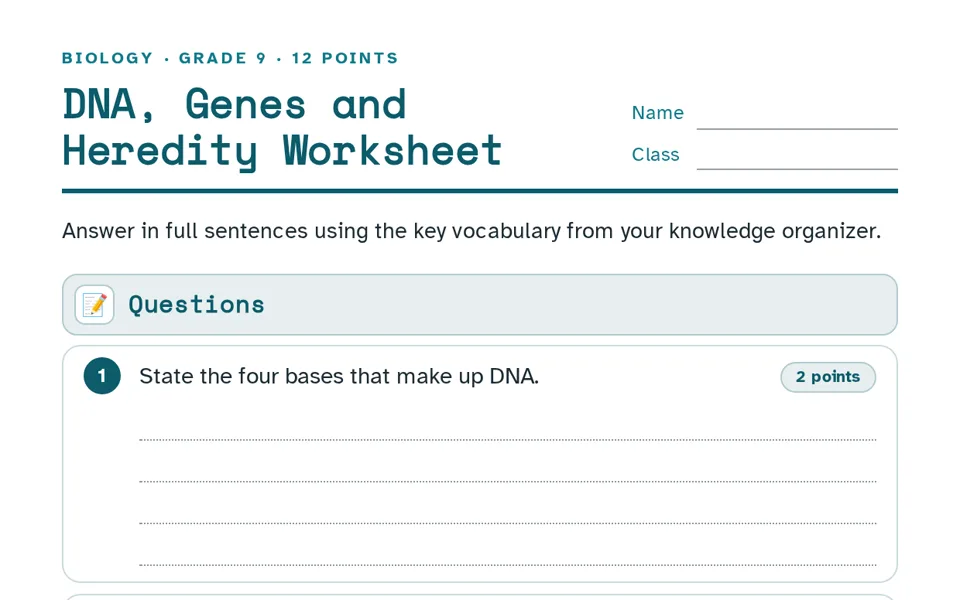
Teaching Gene Expression and Regulation in AP Biology
This topic covers how the information stored in DNA is used to build proteins and functional RNA molecules, and how cells control which genes are active at a given time. Students trace the flow of information from DNA to RNA to protein, including transcription, RNA processing in eukaryotes, and translation at the ribosome.
Regulation explains how cells with the same genome can look and function very differently. Students compare operons in prokaryotes with transcription factors, enhancers, and epigenetic changes in eukaryotes. The topic matters across the course because it connects to heredity, cell differentiation, development, evolution, and biotechnology. Students must also predict how a mutation or a change in regulation alters a protein or a phenotype, and explain their reasoning using data and models.
Key ideas
Central dogma
Information generally flows from DNA to RNA to protein. DNA is transcribed into RNA, and mRNA is translated into a polypeptide. Some viruses, such as retroviruses, use reverse transcriptase to make DNA from RNA.
Transcription
RNA polymerase binds a promoter and builds an RNA strand complementary to the template strand of DNA, reading it 3' to 5' and building the RNA 5' to 3'. In RNA, uracil pairs with adenine in place of thymine.
Eukaryotic RNA processing
Pre-mRNA receives a 5' cap and a poly-A tail, and introns are removed by splicing while exons are joined. Alternative splicing lets one gene code for more than one protein.
Translation
Ribosomes read mRNA codons, and tRNAs with matching anticodons bring specific amino acids. Translation starts at a start codon (AUG), proceeds through elongation, and ends at a stop codon. The genetic code is nearly universal and redundant, since several codons can code for the same amino acid.
Prokaryotic regulation
Operons group related genes under shared control. In the lac operon, a repressor blocks transcription when lactose is absent, and allolactose inactivates the repressor so genes can be expressed. In the trp operon, tryptophan acts as a corepressor that shuts off its own synthesis.
Eukaryotic regulation
Gene expression is controlled by transcription factors, activators, repressors, and enhancers. Chromatin changes such as DNA methylation and histone modification affect access to genes, and these epigenetic marks can be passed on when cells divide. Regulatory differences produce cell differentiation.
Mutations and variation
Changes in DNA sequence can be substitutions, insertions, or deletions. Frameshift mutations from insertions or deletions that are not multiples of three often have a larger effect than substitutions, but some mutations have no effect on the protein. Mutations are a source of genetic variation on which natural selection acts.
Key vocabulary
- Promoter
- A DNA sequence where RNA polymerase and transcription factors bind to begin transcription.
- Codon
- A three-nucleotide sequence in mRNA that specifies an amino acid or a stop signal.
- Anticodon
- A three-nucleotide sequence on a tRNA that pairs with a complementary mRNA codon.
- Intron
- A noncoding region of pre-mRNA that is removed before translation.
- Exon
- A region of mRNA that remains after splicing and can be translated into protein.
- Operon
- A cluster of genes in prokaryotes with a shared promoter and operator, transcribed together under common control.
- Transcription factor
- A protein that binds DNA or other proteins to increase or decrease transcription of a gene.
- Epigenetic modification
- A chemical change to DNA or histones, such as methylation, that affects gene expression without changing the DNA sequence.
Common misconceptions
- Error: Cells in one organism have different DNA because they have different functions. Fix: Nearly all cells of an organism carry the same genome, and differences come from which genes are expressed.
- Error: A repressor in the lac operon is turned on by lactose. Fix: In the lac operon, the inducer allolactose binds the repressor and prevents it from blocking transcription.
- Error: Every mutation changes the protein and is harmful. Fix: Because the code is redundant, a silent mutation may not change the amino acid, and some changes have little effect or are beneficial in certain environments.
- Error: Translation happens in the nucleus of eukaryotic cells. Fix: Transcription and RNA processing occur in the nucleus, while translation occurs on ribosomes in the cytoplasm or on the rough ER.
What the exam asks for
- Explaining how a change in DNA sequence, a regulatory protein, or an environmental signal leads to a change in protein production or phenotype.
- Analyzing experimental data, such as results from operon mutants or gene expression under different conditions, and justifying a claim with evidence.
- Using the genetic code table to determine an mRNA sequence, tRNA anticodons, or an amino acid sequence from a DNA template.
- Interpreting models and diagrams of transcription, translation, and regulation, and predicting the effect of changing one component.
Practice questions with answers
A DNA template strand reads 3'-TACGGT-5'. Write the mRNA sequence it produces and label its ends.
5'-AUGCCA-3'. RNA is built complementary and antiparallel to the template, with uracil in place of thymine.
Explain why a mutation that deletes one nucleotide in the middle of a coding sequence is often more damaging than one that substitutes a single nucleotide.
The deletion shifts the reading frame, so every codon after the deletion changes, which usually alters many amino acids or creates an early stop codon. A substitution changes only one codon, which may be silent or change just one amino acid.
Describe two ways eukaryotic cells process pre-mRNA before it leaves the nucleus.
Any two of: adding a 5' cap, adding a poly-A tail, splicing out introns and joining exons. Alternative splicing can also be mentioned.
E. coli cells are grown with glucose and no lactose, then moved to a medium with lactose and no glucose. (a) Describe how the lac operon responds. (b) Predict the effect of a mutation in the repressor gene that prevents the repressor from binding the operator. (c) Explain how this regulation benefits the cell.
(a) Lactose is converted to allolactose, which binds the repressor and changes its shape so it no longer binds the operator. RNA polymerase can then transcribe the genes for lactose use, and with low glucose the cell can express them well. (b) The genes would be transcribed continuously, whether or not lactose is present, because nothing blocks the operator. (c) The cell makes enzymes only when the substrate is available, saving energy and materials. A strong response links each claim to the molecular mechanism.
Make any AP Biology resource on Gene Expression and Regulation
Pick what you need - the AI builds it for AP Biology and keeps everything consistent if you generate more.
Gene Expression and Regulation lesson plans
Gene Expression and Regulation worksheets
Gene Expression and Regulation study guides
Gene Expression and Regulation slides
Gene Expression and Regulation test prep & review
Gene Expression and Regulation activities
Gene Expression and Regulation practice test
AP Biology: Gene Expression and Regulation - FAQ
Are these resources aligned to the AP Biology framework?
Yes - every resource on Gene Expression and Regulation is written for the AP course framework - with exam-style free-response and the scoring guidelines in mind. It is pitched for High School (Grades 9-12) and the demands of the AP exam.
What can I make for Gene Expression and Regulation?
A full lesson on Gene Expression and Regulation - slides, a lesson plan, a worksheet with an answer key, a study guide, review practice, an exit ticket and a self-grading practice test - each generated in about 60 seconds.
Are the Gene Expression and Regulation resources editable?
Yes. Slides open in Google Slides or PowerPoint and documents open in Word or Google Docs, or save as a PDF - fully editable and yours to keep.
Is it free?
You can start free with no credit card. Generate a AP Biology lesson on Gene Expression and Regulation and see the quality for yourself.
Teach Gene Expression and Regulation tomorrow.
A full AP Biology lesson in 60 seconds - free to start, no credit card.