Teaching The Three Branches of Government: High School Government & Civics key ideas, vocabulary and misconceptions
What High School students need to know about The Three Branches of Government, the words they need and the mistakes to watch for. Then make an editable lesson, worksheet or study guide on it, standards-aligned and free to start.
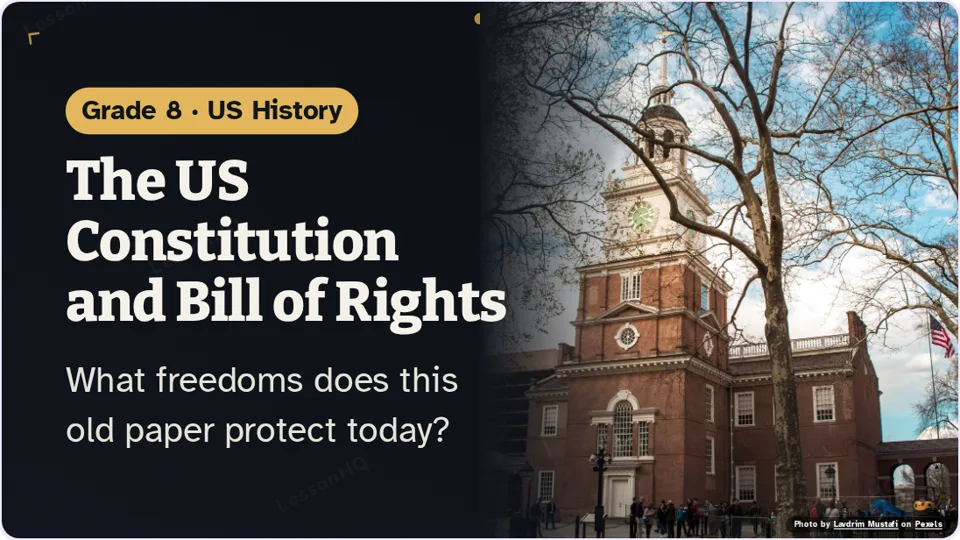
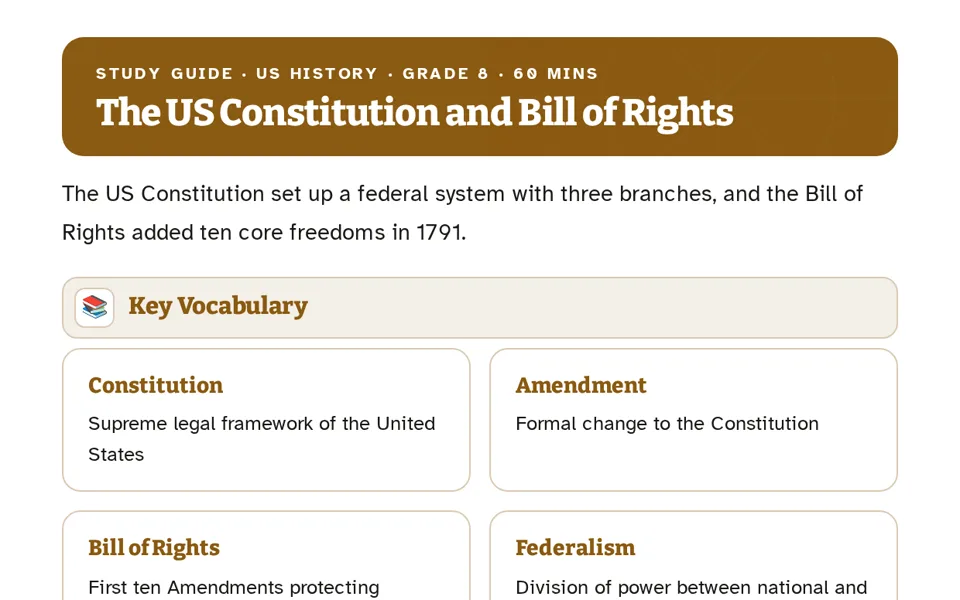
Teaching The Three Branches of Government at High School
Students examine the legislative, executive and judicial branches established in Articles I, II and III of the Constitution. By the end they should explain each branch's powers, describe separation of powers, and give examples of checks and balances, such as the veto, veto override, confirmation and judicial review.
Key vocabulary
- separation of powers
- dividing government powers among separate branches so no one branch holds all power
- checks and balances
- the ways each branch can limit the powers of the others
- veto
- the president's power to reject a bill passed by Congress
- judicial review
- the courts' power to declare laws or actions unconstitutional
- impeachment
- the House's power to formally charge an official, who is then tried by the Senate
Common misconceptions
- Students often think impeachment means removal from office, but it is the formal charge; removal requires conviction by two-thirds of the Senate.
- Many believe the president makes laws, but Congress writes and passes laws while the president signs or vetoes them.
- Some think judicial review is spelled out in the Constitution, but it was established by the Supreme Court in Marbury v. Madison.
The Three Branches of Government: key ideas, a teaching sequence and practice
At the high school level, students move past naming the three branches and start explaining why the framers divided power and how the branches actually interact. They read Articles I, II and III as a design: Congress makes laws, the president carries them out, and the federal courts interpret them and decide cases.
This builds on middle school civics, where students learned the basic job of each branch and the idea of limited government. Now they connect the structure to the framers' fear of concentrated power, to the Constitution's two-house Congress, and to real conflicts between branches. The goal is for students to trace a bill or a court case through the system and explain which branch holds which power, and which other branch can respond.
Key ideas
Article I gives Congress the lawmaking power
Congress is made up of the House of Representatives and the Senate. It can pass laws, collect taxes, borrow money, regulate commerce among the states, and declare war. A bill must pass both chambers before it goes to the president.
Article II vests executive power in the president
The president enforces federal law, serves as commander in chief of the armed forces, makes treaties with Senate approval, and appoints officials and judges. The executive branch also includes the vice president and the departments and agencies that carry out laws.
Article III creates the federal judiciary
The Constitution creates one Supreme Court and lets Congress create lower federal courts. Judges interpret laws and decide cases. Under judicial review, a power the Supreme Court established in Marbury v. Madison (1803) rather than one written in Article III, courts can strike down laws that conflict with the Constitution. Federal judges are nominated by the president and confirmed by the Senate.
Separation of powers spreads authority
Each branch has its own main job and its own set of officeholders. The framers had seen how power held by one person or group could be abused, so they split government functions apart.
Checks and balances make the branches overlap
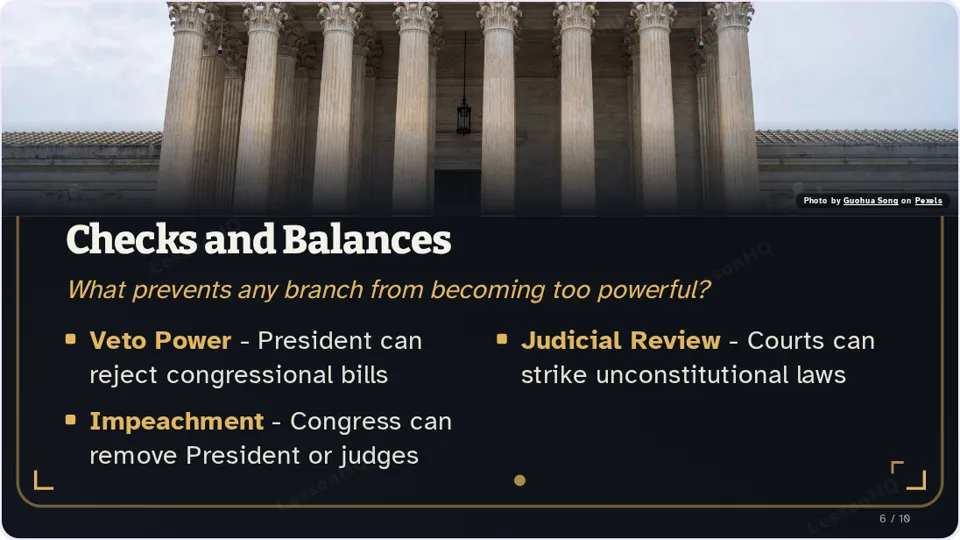
The branches are not fully walled off from one another. Congress can override a veto with a two-thirds vote in each chamber, the Senate confirms appointments, the courts can review laws and executive actions, and Congress can impeach officials.
Each branch is limited by the others
Presidents depend on Congress for funding and laws, Congress depends on the president to enforce what it passes, and both are bound by the Constitution as the courts interpret it. Students should see this as a system of mutual limits.
Tensions between the branches are normal
Disagreements over war powers, appointments, and the limits of executive authority recur in American history. Students can analyze these disputes using the constitutional text and decide which branch's claim is stronger.
A teaching sequence
- Begin with a quick write asking students what could go wrong if one person made, enforced, and judged the laws, so they see why separation of powers matters.
- Have students read key passages from Articles I, II and III and fill in a chart listing each branch's powers with the article that grants them.
- Walk through how a bill becomes law, then add the veto and the override to show a check in action.
- Give small groups scenarios, such as a court striking down a law or the Senate rejecting a nominee, and have them name the branches involved and the check being used.
- Close with a short written argument on whether the system makes government too slow or properly cautious, using at least two checks as evidence.
Practice questions with answers
Which branch writes federal laws, and which branch enforces them?
Congress, the legislative branch, writes and passes laws. The executive branch, headed by the president, enforces them.
Name two ways Congress can check the president.
Congress can override a veto with a two-thirds vote in both chambers, and the Senate can refuse to confirm nominees. Congress can also impeach and remove a president, or control funding.
A federal court rules that a law violates the Constitution. Which power is the court using, and which branches are involved?
The court is using judicial review. The judicial branch is checking the legislative branch, which passed the law, and possibly the executive branch, which enforces it.
Explain how the appointment of a Supreme Court justice involves two branches.
The president nominates the justice and the Senate votes on confirmation. This shares the power between the executive and legislative branches.
Why did the framers choose separation of powers instead of putting authority in one strong body?
They feared that concentrated power could lead to tyranny. Dividing it among three branches that can limit each other makes abuse harder.
Try it at home
Watch or read a short news story about Congress, the president, or a court decision together and ask your teen which branch is acting and which other branch could respond. You can also compare it to how decisions are made and checked in your own household or community groups.
Standards this covers
- D2.CIV.4.9-12: Students explain how the structure of the U.S. government, including the three branches and their checks, works in practice.
- D2.CIV.3.9-12: Students analyze how the Constitution shapes the powers of government and maintains order.
Make any resource on The Three Branches of Government
Pick what you need - the AI builds it for High School Government & Civics, then keeps everything consistent if you generate more.
The Three Branches of Government lesson plans
The Three Branches of Government worksheets
The Three Branches of Government study guides
The Three Branches of Government slides
The Three Branches of Government test prep & review
The Three Branches of Government activities
Ready-made High School Government & Civics resources
Finished resources from the LessonHQ Library, closest to The Three Branches of Government first.
- Knowledge Check: The Three Branches of GovernmentActivity Sheet · High School US Government · $1.99
- Knowledge & Homework Booklet: The Three Branches of GovernmentHomework Booklet · High School US Government · $2.49
- The Three Branches of GovernmentExit Ticket · High School US Government · $0.99
- The Three Branches of GovernmentStudy Guide · High School US Government · $1.49
- The Three Branches of GovernmentLesson Plan · High School US Government · $1.99
- The Three Branches of GovernmentSub Plan · High School US Government · $1.99
The Three Branches of Government - FAQ
What High School Government & Civics resources can I make for The Three Branches of Government?
A full lesson on The Three Branches of Government - slides, a lesson plan, a worksheet, a study guide, retrieval practice and more - each generated in about 60 seconds and aligned to US state standards for High School.
Are the The Three Branches of Government resources editable?
Yes. Slides open in Google Slides or PowerPoint and documents open in Word or Google Docs, or save as a PDF - fully editable and yours to keep.
Is it pitched at the right level for High School?
Yes - every resource on The Three Branches of Government is written for Grades 9-12 (ages 14-18): rigorous lessons with analysis and evidence, aligned to state standards and AP.
Is it free?
You can start free with no credit card. Generate a The Three Branches of Government lesson and see the quality for yourself.
Aligned to your state's standards
The Three Branches of Government resources map to your state's standards and tests, not a generic template.
- Texas
- California
- Florida
- New York
- Virginia
- Georgia
- Pennsylvania
- Tennessee
- North Carolina
- Indiana
- Oklahoma
- South Carolina
- Arizona
- Nebraska
- Minnesota
- Alaska
- Ohio
- Michigan
- Massachusetts
- Washington
- Colorado
- Maryland
- Missouri
- Wisconsin
- Alabama
- Louisiana
- Kentucky
- Utah
- Iowa
- Kansas
- Mississippi
- Idaho
- West Virginia
- Illinois
- New Jersey
- Connecticut
- Oregon
- Nevada
- New Mexico
- Arkansas
- Montana
- Hawaii
- Maine
- New Hampshire
- Vermont
- Rhode Island
- Delaware
- Wyoming
- North Dakota
- South Dakota
- District of Columbia
Teach The Three Branches of Government tomorrow.
A full High School Government & Civics lesson pack in 60 seconds - free to start, no credit card.