Constitution Day and Citizenship Day lesson ideas and resources
Constitution Day lesson plans for Pre-K to 12th grade: rules and fairness, the Preamble, the Bill of Rights, the three branches and what citizenship means. Every idea below is one click from ready-made slides.
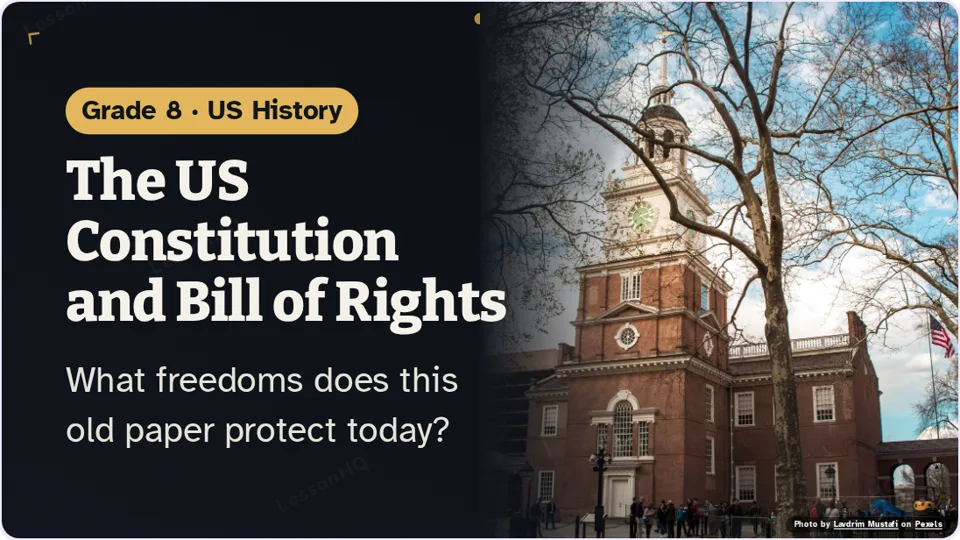
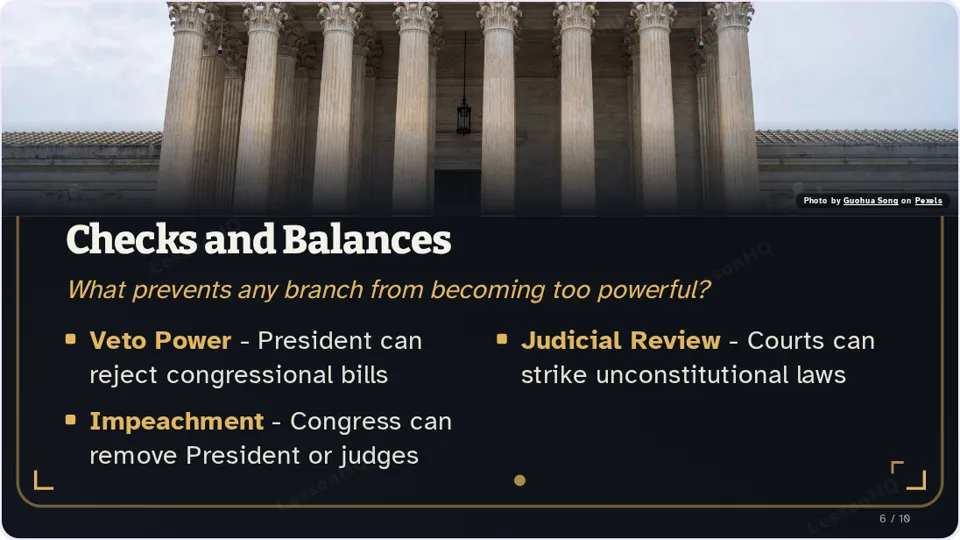
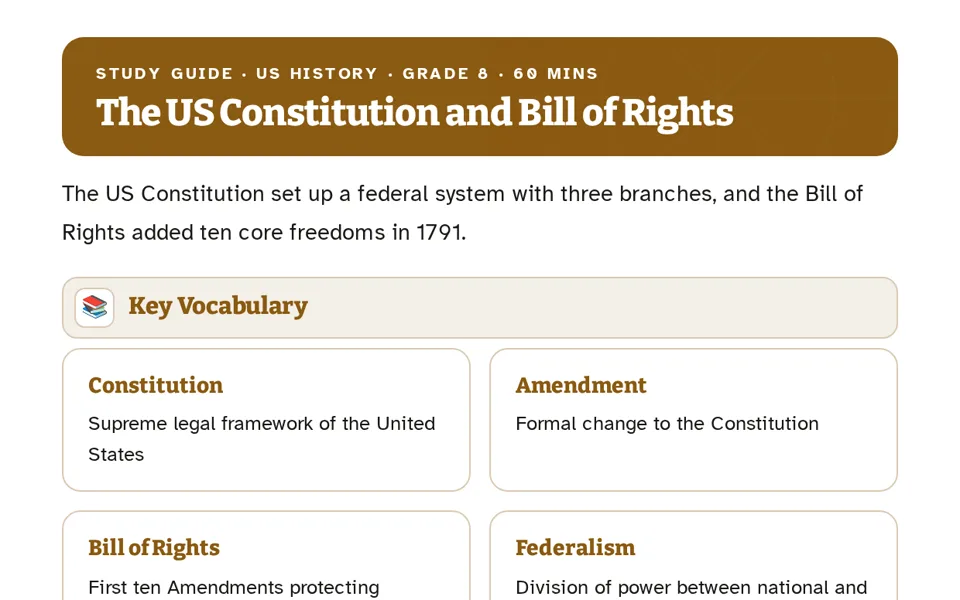
Constitution Day is September 17, the anniversary of the signing of the Constitution in 1787. Schools that receive federal funding must hold an educational program about the Constitution on that day; when it falls on a weekend or holiday, the program is held during the week before or after.
Planning Constitution Day in school
Check the calendar early: if September 17 falls on a weekend, plan your program for the nearest school day. Choose one focused activity per grade, such as the Preamble, the Bill of Rights or the branches of government, and use free primary sources from the National Archives.
Most teachers start planning 2 to 6 weeks ahead. Pick an idea for your grade below and press Slides: the generator opens with the topic, grade and subject filled in, so you only check the options and press Generate.
Why Constitution Day and Citizenship Day matters
On September 17, 1787, 39 delegates to the Constitutional Convention in Philadelphia signed the Constitution of the United States. It set out a framework for the national government, with powers divided among three branches and between the federal government and the states. It was ratified in 1788, and the Bill of Rights, the first ten amendments, was added in 1791.
Since 2004, federal law has required schools and colleges that receive federal funds to hold an educational program about the Constitution each year on September 17. The day is also Citizenship Day, which recognizes people who have become US citizens and the rights and responsibilities citizenship brings.
Constitution Day is a chance to help students understand how their government works, why rules and rights matter, and how ordinary people have used the Constitution and its amendments to shape the country over more than two centuries.
Constitution Day and Citizenship Day lesson ideas by grade
Every idea opens a generator pre-filled for that age group. Slides works without an account; worksheets and full lesson packs use a free account.
Constitution Day: Pre-K and Kindergarten (ages 4-6)
Focus on rules, fairness and working together. A constitution is a set of important rules for a country.
Our class rules
Talk about why we need rules, agree on a few class rules together and have everyone sign them like a class constitution.
Taking turns and being fair
Play games that need fair rules, and talk about what happens when rules are not fair.
Symbols of our country
Learn about the flag, the bald eagle and the Liberty Bell, and draw or color one of them.
Constitution Day: Grades 1-2 (ages 6-8)
Students can learn that the Constitution is a plan for government and that people have rights and responsibilities.
What is the Constitution?
Learn that the Constitution is the plan for how our government works, signed in 1787, and make a simple fact page.
Rights and responsibilities
Sort examples into rights and responsibilities at school and in the community.
A class preamble
Read a simplified Preamble, then write a class preamble that says what kind of class we want to be.
Constitution Day: Grades 3-5 (ages 8-11)
Students can study the Preamble, the three branches and the Bill of Rights in age-appropriate ways.
The three branches of government
Learn the roles of the legislative, executive and judicial branches, and how checks and balances work, using a diagram.
The Preamble decoded
Break the Preamble into phrases, put each into kid-friendly words and illustrate one purpose of government.
The Constitutional Convention
Learn about the 1787 Convention, the delegates and key compromises, and create a timeline from the Declaration of Independence to the Bill of Rights.
Constitution numbers
Solve problems with Constitution facts: 39 signers, 27 amendments, years since 1787, using addition and subtraction.
Constitution Day: Grades 6-8 / middle school (ages 11-14)
Middle schoolers can analyze the text of the Constitution, the debates over ratification and the Bill of Rights.
The Bill of Rights in action
Match real-life scenarios to the amendments in the Bill of Rights, and discuss how they protect individuals.
Federalists and Anti-Federalists
Compare Federalist and Anti-Federalist arguments about ratification using primary source excerpts.
How a bill becomes a law
Follow a bill through Congress to the president, then simulate the process with a class bill.
Constitution Day: Grades 9-12 / high school (ages 14-18)
High school students can analyze constitutional principles, landmark Supreme Court cases and amendments, presenting multiple perspectives.
Landmark Supreme Court cases
Analyze cases such as Marbury v. Madison, Brown v. Board of Education and Tinker v. Des Moines, and the constitutional principles involved.
Amending the Constitution
Study the amendment process and selected amendments, and evaluate why only 27 amendments have been ratified.
The naturalization test
Take sample questions from the US civics test for naturalization and discuss what citizens should know.
Teaching Constitution Day well: sensitivity notes
A few things worth thinking about before you plan, so every child in the room feels included and the facts stay accurate.
Constitution Day and Citizenship Day: questions teachers ask
When is Constitution Day?
Constitution Day is September 17 each year. The next one is Friday, September 17, 2027. If it falls on a weekend or holiday, schools hold their program during the week before or after.
Do schools have to teach about the Constitution on Constitution Day?
Yes. Since 2004, federal law has required schools and colleges that receive federal funds to hold an educational program about the Constitution on September 17.
What is Citizenship Day?
September 17 is also Citizenship Day, which recognizes people who have become US citizens. Many naturalization ceremonies are held around this date.
Can I make Constitution Day resources with LessonHQ for free?
Yes. Open the slide generator from any idea on this page and make up to 3 slide decks with no sign-up. A free account adds 2 full lesson packs to start (plan, slides, worksheet and more), then 3 free packs every month, with no card needed. Everything is pre-filled with the topic, grade and subject, and exports as editable PowerPoint, Google Slides, Word or PDF.
More holidays and awareness days
Make Constitution Day slides free
No sign-up for your first 3 decks. Free plan: 2 lesson packs to start, then 1 every month, no card.