AP US Government: The Supreme Court in 60 seconds
Everything you need to teach The Supreme Court for AP US Government - slides, a lesson plan, a worksheet with an answer key, a study guide and review practice, all built around the same key vocabulary and pitched to the AP framework. Editable and free to start.
Teaching The Supreme Court in AP US Government
The Supreme Court is the highest court in the federal judiciary and the final interpreter of the Constitution and federal law. In AP US Government, students study how the Court gets its power, how it chooses and decides cases, and how its rulings shape civil liberties, civil rights, and the balance of power among the branches and between national and state governments.
This topic matters because many of the course's required Supreme Court cases come together here. Students need more than a list of rulings. They must explain the constitutional provision behind each decision, the reasoning the Court used, and the effect on policy and on the other branches. Students also compare judicial philosophies, analyze how the Court is limited by the president, Congress, and public opinion, and connect the Court's decisions to larger ideas such as federalism, separation of powers, and individual rights.
Key ideas
Judicial review
Judicial review is the power of federal courts to decide whether laws and executive actions violate the Constitution. The Court established it in Marbury v. Madison (1803), when it held part of the Judiciary Act of 1789 unconstitutional.
Structure and appointment
Article III creates one Supreme Court and lets Congress create lower federal courts. Justices are nominated by the president, confirmed by the Senate, and serve during good behavior, which in practice means life tenure unless they resign, retire, or are impeached and removed.
How cases reach the Court
Most cases come on appeal from lower federal courts or state supreme courts. Parties ask for a writ of certiorari, and the Court agrees to hear only a small share of petitions, often when lower courts disagree or an important constitutional question is raised. Four justices must vote to grant review (the rule of four).
Deciding cases
After briefs and oral argument, the justices meet in conference and vote. The majority opinion states the ruling and reasoning, and it sets precedent. Justices may also write concurring opinions, which agree with the result for different reasons, or dissenting opinions.
Precedent and judicial philosophy
Stare decisis is the principle that courts generally follow earlier decisions. The Court can still overturn precedent, as in Brown v. Board of Education (1954), which rejected the separate-but-equal approach of Plessy v. Ferguson. Judicial activism and judicial restraint describe differing views of how willing courts should be to strike down laws or policies.
Checks on the Court
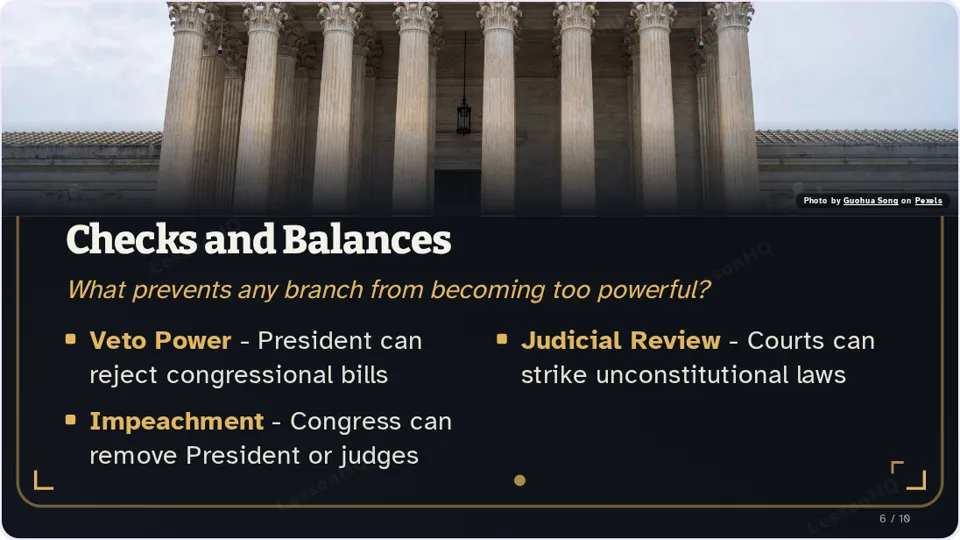
The president appoints justices and enforces rulings, and the Senate confirms them. Congress can propose constitutional amendments, change the Court's appellate jurisdiction, pass new legislation, and impeach judges. The Court has no army or budget power of its own, so it depends on other actors to carry out its decisions.
Landmark cases and federalism
McCulloch v. Maryland (1819) upheld implied powers and national supremacy over state action. United States v. Lopez (1995) limited Congress's use of the commerce clause. These cases show how the Court helps define the balance between national and state power.
Key vocabulary
- judicial review
- The power of courts to strike down laws and government actions that conflict with the Constitution.
- writ of certiorari
- An order from the Supreme Court agreeing to review a lower court's decision.
- precedent
- An earlier court decision that guides later decisions in similar cases.
- stare decisis
- The principle that courts should generally follow established precedent.
- majority opinion
- The opinion that states the Court's decision and reasoning when most justices agree.
- dissenting opinion
- An opinion written by a justice who disagrees with the Court's decision.
- judicial restraint
- A philosophy that courts should defer to elected branches and avoid overturning laws unless clearly unconstitutional.
- judicial activism
- A label for the view that courts should use their power more actively to strike down laws and address policy problems.
Common misconceptions
- Students often think the Supreme Court must hear every appeal. In fact, it chooses most of its cases through certiorari and refuses most petitions.
- Students may say the Constitution explicitly grants judicial review. The power is not stated in the text; it was established by the Court in Marbury v. Madison.
- Students sometimes believe the Court's rulings cannot be challenged. Congress and the states can respond through constitutional amendments, Congress can pass new legislation, the president and Senate shape the Court through appointments, and the Court can reverse itself later.
- Students may think a dissent has legal force. A dissent does not change the outcome or create binding precedent, though it can shape later arguments.
What the exam asks for
- Explaining how a required Supreme Court case connects to a constitutional provision and describing its reasoning and effect.
- Comparing two cases, such as Marbury v. Madison and McCulloch v. Maryland, and identifying similarities or differences in reasoning or outcomes.
- Describing how other branches or the states can check or respond to Court decisions, using specific examples.
- Reading a passage from a case or a short scenario and applying course concepts such as judicial restraint, precedent, or federalism.
Practice questions with answers
What is judicial review, and which case established it?
Judicial review is the power of courts to decide whether laws and government actions violate the Constitution. It was established in Marbury v. Madison (1803).
Explain what the rule of four is and why it matters.
The rule of four says four justices must vote to hear a case. It matters because it determines which petitions for certiorari are granted, so a minority of the Court can place a case on its docket.
Identify one way Congress can check the Supreme Court.
Acceptable answers include proposing a constitutional amendment, passing new legislation in response to a ruling, changing the Court's appellate jurisdiction, confirming or rejecting nominees through the Senate, or impeaching judges.
Free response: Explain how the Supreme Court's decision in McCulloch v. Maryland (1819) illustrates both federalism and the Court's role in interpreting the Constitution. In your response, (a) describe the decision, (b) explain its connection to the necessary and proper clause and the supremacy clause, and (c) explain how a later case such as United States v. Lopez (1995) shows that the Court can also limit national power.
A strong response includes: (a) the Court upheld Congress's power to create a national bank and held that Maryland could not tax it. (b) The necessary and proper clause supports implied powers beyond those listed in Article I, and the supremacy clause means valid federal law prevails over conflicting state action. (c) In Lopez, the Court ruled that Congress exceeded its commerce clause power by banning guns near schools, showing the Court can set limits on national authority. The response should tie both cases to the Court's role in defining the balance between national and state governments through judicial review.
Make any AP US Government resource on The Supreme Court
Pick what you need - the AI builds it for AP US Government and keeps everything consistent if you generate more.
The Supreme Court lesson plans
The Supreme Court worksheets
The Supreme Court study guides
The Supreme Court slides
The Supreme Court test prep & review
The Supreme Court activities
The Supreme Court practice test
AP US Government: The Supreme Court - FAQ
Are these resources aligned to the AP US Government framework?
Yes - every resource on The Supreme Court is written for the AP course framework - with exam-style free-response and the scoring guidelines in mind. It is pitched for High School (Grades 9-12) and the demands of the AP exam.
What can I make for The Supreme Court?
A full lesson on The Supreme Court - slides, a lesson plan, a worksheet with an answer key, a study guide, review practice, an exit ticket and a self-grading practice test - each generated in about 60 seconds.
Are the The Supreme Court resources editable?
Yes. Slides open in Google Slides or PowerPoint and documents open in Word or Google Docs, or save as a PDF - fully editable and yours to keep.
Is it free?
You can start free with no credit card. Generate a AP US Government lesson on The Supreme Court and see the quality for yourself.
Teach The Supreme Court tomorrow.
A full AP US Government lesson in 60 seconds - free to start, no credit card.